Choosing to Rent a Car
During our previous two Taiwan trips, we had avoided the option of renting cars, preferring public transport and hiring a driver instead.
For this trip, we wanted to have more flexibility and freedom since we planned for some nature walks, so car rental in Taiwan became a very attractive option for us. Furthermore, there were some destinations that would be difficult to access, such as the Xitou Nature Education Area (溪頭自然教育園區) and Sun Link Sea Forest Recreation Area (杉林溪森林). These are places that are high up in the mountains and it would be unlikely that we would be able to book a taxi or Uber ride for these locations.
One concern was the Left-Hand Driving (LHD) in Taiwan, which was different than the Right-Hand Driving (RHD) practiced in Singapore. However, having driven in several European countries which also used LHD, I believed that I would be able to quickly get used to the different driving sides.
Knowing that the Taipei traffic was not friendly for foreigners (and even for locals which do not stay in Taipei), we planned our car rental to be within the Taichung, Miaoli and Nantou regions only.
After reading some online reviews, we decided to book our rental car via KLOOK (pick up from Taichung High Speed Rail Station), where there were many available options. I specially read through the many user reviews for each rental company.
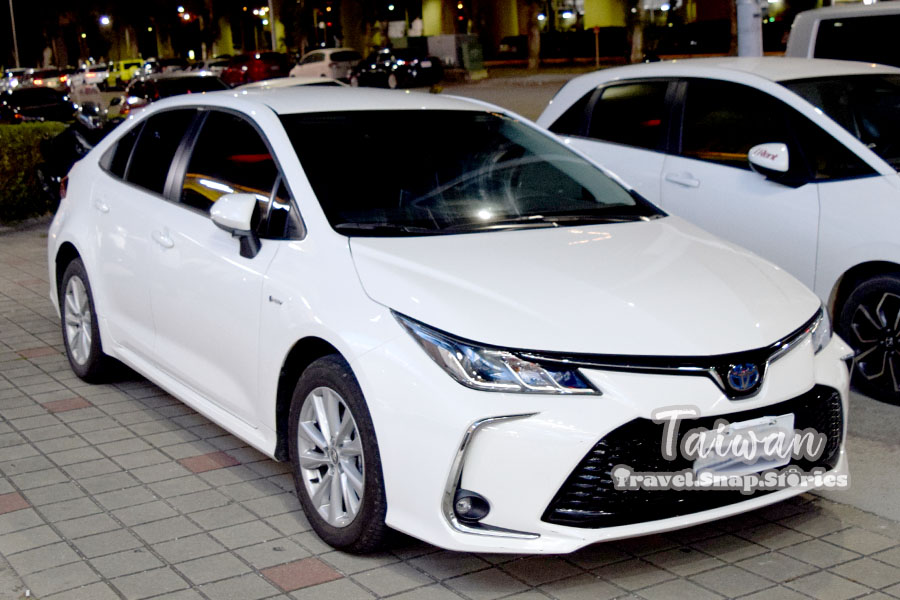
After our good experiences driving in Japan Fujikawaguchiko, we wanted to rent a newer version of Toyota Altis. We soon decided on this company called ‘IWS’, which had good user reviews and had a 2024/25 model of the car available. To have a peace of mind during our driving, we chose the KLOOK Protection insurance. There are always risks involving when driving in a foreign country, so we do not save on car insurances and ended up paying a hefty sum due to car accidents.
Next, we started to apply for the International Driving Permit (IDP), which can be applied on the spot physically at any of the Automobile Association Of Singapore (AAS) branches. We applied ours on a Saturday morning and got ours on the spot within an hour.
We also bought an inflatable booster seat (BubbleBum Inflatable Car Booster Seat from Pupsik studio) for our 10-year-old daughter, so that we could be sure that she would be well protected in the event of a car accident. The seatbelt could be placed at the correct position on her body when she was raised higher on the seat, preventing it from cutting her.
Picking Up the Car
On the day of our car rental, we arrived at Taichung HSR Station. Assuming that the IWS counter to be conveniently located within the station itself, I had not performed any research on the directions to it prior to that day.
In the end, we kept walking around in circles and end up asking a station stuff before she directed us to Exit 7 (taxi pick up area). Once exiting, we saw the IWS office a distance away. We were surprised as we had thought it was inside the station or next to it. We had to walk 5 minutes across the road, crossing a traffic junction, pulling our luggage.
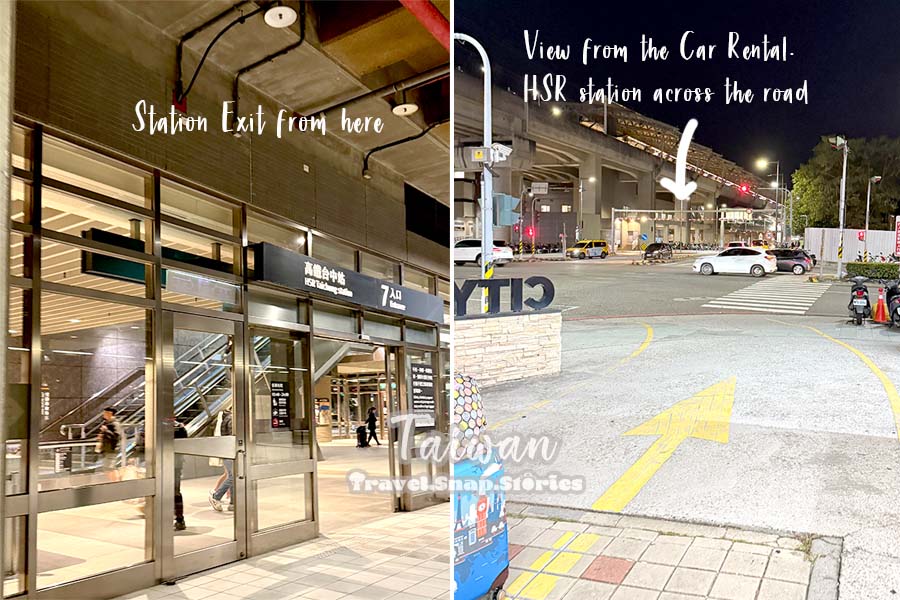
Picking up the car was a fuss-free experience. I produced my IDP, local driving license and passport (note that all these have to be the physical and actual documents and not photocopies). The staff walked me through some basic traffic rules in Taiwan and what to watch out for.
There was no problem fitting our three luggage (24-inch and small 20-inch) into the car boot as well.
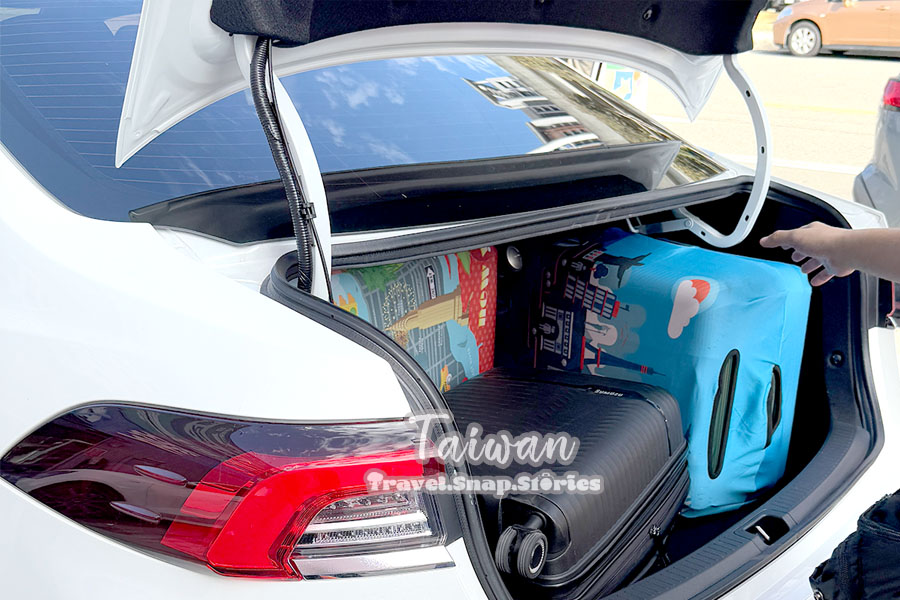
We collected the car on full tank, and would thus need to return it on full tank as well. There were several petrol stations within a 5-minute drive, so that was not a problem at all.
As for the highway tolls, they would be automatically charged when passing through the highways and the final toll would be calculated and paid (in cash) upon returning the car. This was a convenient approach since we need not keep track while driving nor top up a card to be charged when passing through the toll gates.
Before starting, I always remember to inspect the car myself and take some photographs and videos, in case of dispute about damage. After that, we were ready to go!
Car Driving Experiences
The car was very new and in a good condition. The car has been washed and cleaned externally and internally.
The controls were also easy to get used to (we drive a Hyundai Avante in Singapore) and since Apple Carplay was built in as well, we just needed to connect our iPhone to activate it. For this car model, it supports wireless Car play, so even if you have forgotten to bring along your charging cable, you would still be able to connect to the car seamlessly.
With Car play, we would not need to worry about GPS navigation and music entertainment, since everything could be controlled from our phone.
The road conditions were good and we hardly encountered any potholes or uneven roads. The main roads were easy to drive too, following the road signs and arrows on the roads.
Small Countryside roads – Two lanes?
However, the minor roads were much more challenging to navigate as the GPS navigated us through these narrow roads. You would need to be able to gauge the boundaries of the sides of your car, so that you would not accidentally scratch the car against the walls or objects on both sides of the roads.
Furthermore, many of these narrow roads were meant for two-way traffic, although their widths appear to be able to accommodate one vehicle at one time only.
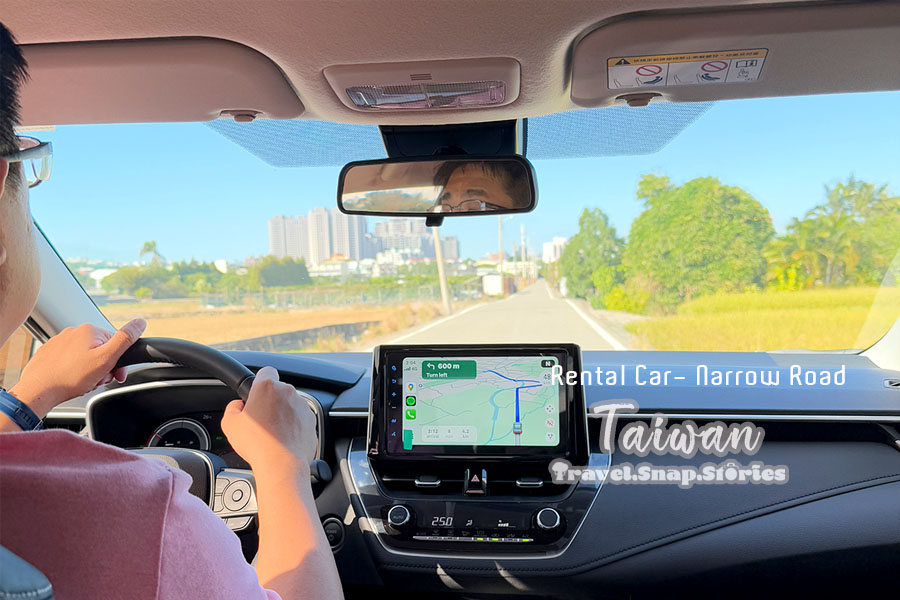
As a result, the driver would need to be able judge in advance if another car in the opposite direction is approaching soon and if so, locate a wider portion of the road to move to the side so that the other car can pass through. Fortunately, the drivers we had encountered were already used to such road conditions so there was not much problem giving way or having the other parties giving way to us.
There would be a high compensation for scratching a rental car, so I would recommend that the driver be experienced or confident with the maneuver of the vehicle with good estimation of how far the car can go, before hitting the wall or getting scratched by the other car.
Winding Roads up and down
We also discovered there were many winding mountainous roads up and down in Taichung and Nantou, so I kept turning cautiously. People sitting at the back might get motion-sickness or be car sick. Cat felt a bit dizzy and suggested taking alternative route if possible and not pass through these type of mountainous routes.
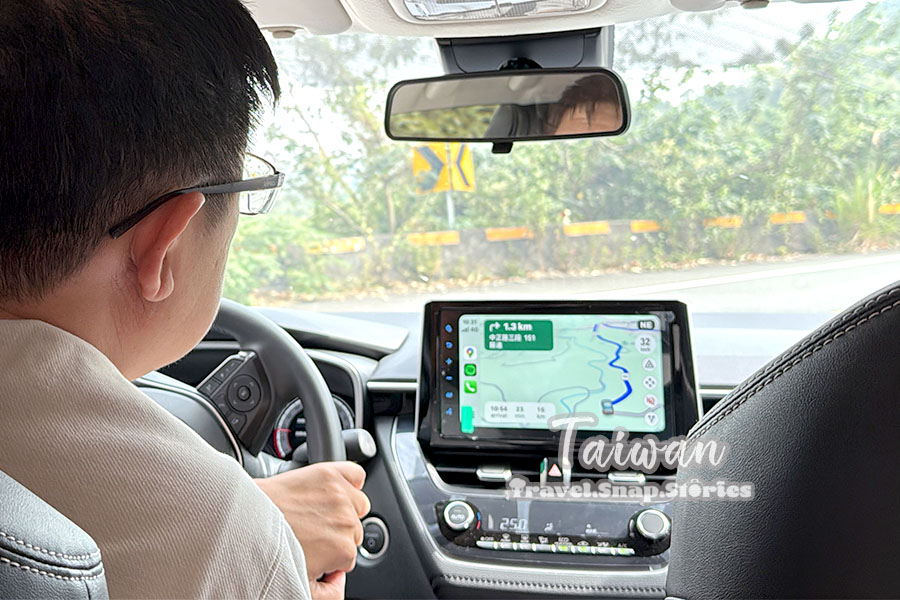
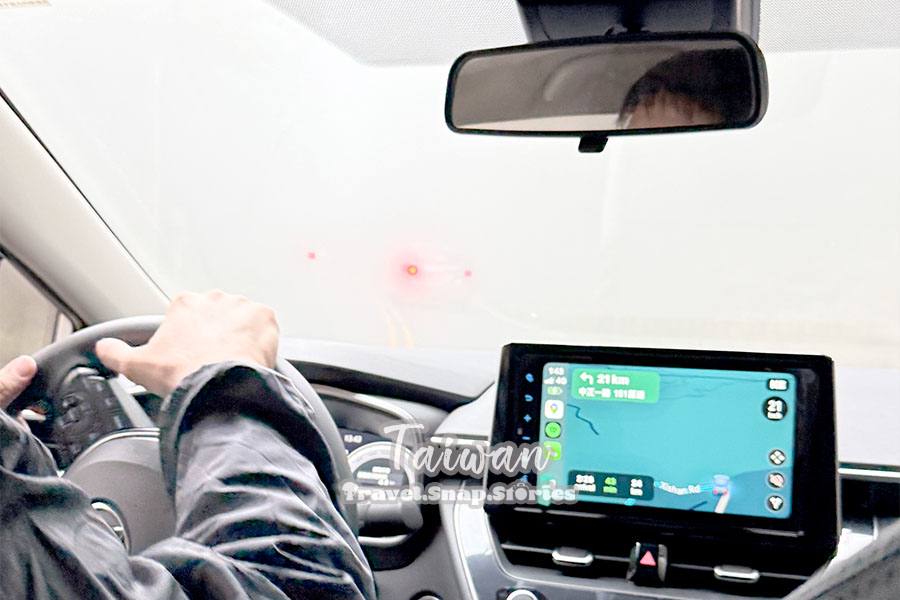
As for the highway, it is expected that slower vehicles keep to the center or right lanes. The leftmost lane is meant for fast-moving vehicles or vehicles looking to overtake. I have witnessed cars driving as fast as more than 120 km/h regularly, so be prepared for that if you choose to drive on the leftmost lane. I was confident of my skills, thus I preferred driving on the leftmost lane when I know the next exit was still far away, to arrive earlier at my destination.
Parking
Parking is a mix of normal and parallel parking lots, with parallel parking lots the only option in the cities where vehicles park along the roadside in the designated lots. As I am not comfortable in parallel parking with a Left-hand drive, I avoided that by opting for private car parks or parked in malls which have the regular car park lots.
The parking for Gaomei Wetlands was a few private lots manned by people who appeared at the roadside holding up a sign for parking price. When we turned into a seemingly empty parking lot, a woman suddenly appeared and demanded money for the parking. We were surprised as there were no gantry or booths. Nevertheless, we still paid up.
For car parks in malls or in establishments (e.g. at Xitou Nature Education Area (溪頭自然教育園區)), you could usually scan the QR codes on the receipts of your purchases to receive rebates for your parking fees.
There should be an option in the parking payment machines to redeem these rebates, so remember to scan the QR codes before paying for the car park fees! At one shopping mall, we managed to fully waived the parking fee for the shopping malls by scanning the QR codes of our receipts.
All the hotels we stayed in provided us free parking for the rental car too.
Recommendation and Conclusion
Overall, it was a fun and comfortable driving experience in Taiwan, giving us a lot of freedom and flexibility as we travel through the different hotels, provinces and places of interests, especially when many of the places we visited were far from the cities and up in the mountains.
We limited each of our journeys to be less than 90 minutes, with the longest drive occurring between Taichung and Miaoli (drove to visit the Flying cown ranch for the day). It is very important that the driver is in an alert state and had rested well the night before. To keep myself awake, I ate some sweets and drank water constantly.
Our decision of not to self drive in Taipei was a sound one, as we witnessed first-hand the chaotic traffic while drivers navigated through the heavy traffic aggressively. We used Uber to hire local taxis (cheaper but takes a longer time to get) and private hires in Taipei instead.
I hope these details help with your decision to drive (or not) in your next trip in Taiwan!
READ Taiwan Dec 2025 Itinerary Summary: 8-Day Taiwan Itinerary – Hsinchu | Taichung | Miaoli | Nantou | Taipei
Past Explorations in Taiwan:
READ Taiwan 2018 Itinerary Summary: 5-Day Taiwan Trip Itinerary: Taipei | Yilan Nature and Fun
READ Taiwan 2012 Itinerary Summary: 8-day Taiwan Itinerary Chiayi | Nantou | Taipei | Hualien